Automatic summarization is the process of shortening a set of data computationally, to create a subset (a summary) that represents the most important or relevant information within the original content. Artificial intelligence (AI) algorithms are commonly developed and employed to achieve this, specialized for different types of data. Text summarization is usually implemented by natural language processing methods, designed to locate the most informative sentences in a given document. On the other hand, visual content can be summarized using computer vision algorithms. Image summarization is the subject of ongoing research; existing approaches typically attempt to display the most representative images from a given image collection, or generate a video that only includes the most important content from the entire collection. Video summarization algorithms identify and extract from the original video content the most important frames (key-frames), and/or the most important video segments (key-shots), normally in a temporally ordered fashion. Video summaries simply retain a carefully selected subset of the original video frames and, therefore, are not identical to the output of video synopsis algorithms, where new video frames are being synthesized based on the original video content. == Commercial products == In 2022 Google Docs released an automatic summarization feature. == Approaches == There are two general approaches to automatic summarization: extraction and abstraction. === Extraction-based summarization === Here, content is extracted from the original data, but the extracted content is not modified in any way. Examples of extracted content include key-phrases that can be used to "tag" or index a text document, or key sentences (including headings) that collectively comprise an abstract, and representative images or video segments, as stated above. For text, extraction is analogous to the process of skimming, where the summary (if available), headings and subheadings, figures, the first and last paragraphs of a section, and optionally the first and last sentences in a paragraph are read before one chooses to read the entire document in detail. Other examples of extraction that include key sequences of text in terms of clinical relevance (including patient/problem, intervention, and outcome). === Abstractive-based summarization === Abstractive summarization methods generate new text that did not exist in the original text. This has been applied mainly for text. Abstractive methods build an internal semantic representation of the original content (often called a language model), and then use this representation to create a summary that is closer to what a human might express. Abstraction may transform the extracted content by paraphrasing sections of the source document, to condense a text more strongly than extraction. Such transformation, however, is computationally much more challenging than extraction, involving both natural language processing and often a deep understanding of the domain of the original text in cases where the original document relates to a special field of knowledge. "Paraphrasing" is even more difficult to apply to images and videos, which is why most summarization systems are extractive. === Aided summarization === Approaches aimed at higher summarization quality rely on combined software and human effort. In Machine Aided Human Summarization, extractive techniques highlight candidate passages for inclusion (to which the human adds or removes text). In Human Aided Machine Summarization, a human post-processes software output, in the same way that one edits the output of automatic translation by Google Translate. == Applications and systems for summarization == There are broadly two types of extractive summarization tasks depending on what the summarization program focuses on. The first is generic summarization, which focuses on obtaining a generic summary or abstract of the collection (whether documents, or sets of images, or videos, news stories etc.). The second is query relevant summarization, sometimes called query-based summarization, which summarizes objects specific to a query. Summarization systems are able to create both query relevant text summaries and generic machine-generated summaries depending on what the user needs. An example of a summarization problem is document summarization, which attempts to automatically produce an abstract from a given document. Sometimes one might be interested in generating a summary from a single source document, while others can use multiple source documents (for example, a cluster of articles on the same topic). This problem is called multi-document summarization. A related application is summarizing news articles. Imagine a system, which automatically pulls together news articles on a given topic (from the web), and concisely represents the latest news as a summary. Image collection summarization is another application example of automatic summarization. It consists in selecting a representative set of images from a larger set of images. A summary in this context is useful to show the most representative images of results in an image collection exploration system. Video summarization is a related domain, where the system automatically creates a trailer of a long video. This also has applications in consumer or personal videos, where one might want to skip the boring or repetitive actions. Similarly, in surveillance videos, one would want to extract important and suspicious activity, while ignoring all the boring and redundant frames captured. At a very high level, summarization algorithms try to find subsets of objects (like set of sentences, or a set of images), which cover information of the entire set. This is also called the core-set. These algorithms model notions like diversity, coverage, information and representativeness of the summary. Query based summarization techniques, additionally model for relevance of the summary with the query. Some techniques and algorithms which naturally model summarization problems are TextRank and PageRank, Submodular set function, Determinantal point process, maximal marginal relevance (MMR) etc. === Keyphrase extraction === The task is the following. You are given a piece of text, such as a journal article, and you must produce a list of keywords or key[phrase]s that capture the primary topics discussed in the text. In the case of research articles, many authors provide manually assigned keywords, but most text lacks pre-existing keyphrases. For example, news articles rarely have keyphrases attached, but it would be useful to be able to automatically do so for a number of applications discussed below. Consider the example text from a news article: "The Army Corps of Engineers, rushing to meet President Bush's promise to protect New Orleans by the start of the 2006 hurricane season, installed defective flood-control pumps last year despite warnings from its own expert that the equipment would fail during a storm, according to documents obtained by The Associated Press". A keyphrase extractor might select "Army Corps of Engineers", "President Bush", "New Orleans", and "defective flood-control pumps" as keyphrases. These are pulled directly from the text. In contrast, an abstractive keyphrase system would somehow internalize the content and generate keyphrases that do not appear in the text, but more closely resemble what a human might produce, such as "political negligence" or "inadequate protection from floods". Abstraction requires a deep understanding of the text, which makes it difficult for a computer system. Keyphrases have many applications. They can enable document browsing by providing a short summary, improve information retrieval (if documents have keyphrases assigned, a user could search by keyphrase to produce more reliable hits than a full-text search), and be employed in generating index entries for a large text corpus. Depending on the different literature and the definition of key terms, words or phrases, keyword extraction is a highly related theme. ==== Supervised learning approaches ==== Beginning with the work of Turney, many researchers have approached keyphrase extraction as a supervised machine learning problem. Given a document, we construct an example for each unigram, bigram, and trigram found in the text (though other text units are also possible, as discussed below). We then compute various features describing each example (e.g., does the phrase begin with an upper-case letter?). We assume there are known keyphrases available for a set of training documents. Using the known keyphrases, we can assign positive or negative labels to the examples. Then we learn a classifier that can discriminate between positive and negative examples as a function of the features. Some classifiers make a binary classification for a test example, while others assign a probability of being a keyphrase. For ins
Self-management (computer science)
Self-management is the process by which computer systems manage their own operation without human intervention. Self-management technologies are expected to pervade the next generation of network management systems. The growing complexity of modern networked computer systems is a limiting factor in their expansion. The increasing heterogeneity of corporate computer systems, the inclusion of mobile computing devices, and the combination of different networking technologies like WLAN, cellular phone networks, and mobile ad hoc networks make the conventional, manual management difficult, time-consuming, and error-prone. More recently, self-management has been suggested as a solution to increasing complexity in cloud computing. An industrial initiative towards realizing self-management is the Autonomic Computing Initiative (ACI) started by IBM in 2001. The ACI defines the following four functional areas: Self-configuration Auto-configuration of components Self-healing Automatic discovery, and correction of faults; automatically applying all necessary actions to bring system back to normal operation Self-optimization Automatic monitoring and control of resources to ensure the optimal functioning with respect to the defined requirements Self-protection Proactive identification and protection from arbitrary attacks
List of video games using NFC
This is a list of video games that use near field communication (NFC) technology. Currently, games have leveraged NFC in unlocking additional features through payment. This takes the form of a direct transaction over NFC or by purchasing a physical item, which signals to the platform that a certain set of features has been purchased (e.g. Skylanders). This list catalogues gaming NFC platforms by device. == Mobile == === Android === Gun Bros. Near Field Ninja NFC Cards Skylanders, with an NFC base. The Haunted House: Soul Fighters, with an NFC base. === iOS === ==== As item-triggered game enhancement ==== Skylanders, with an NFC base. ==== As payment ==== In-App Purchases Here, games that leverage Apple's In-App Purchase framework use information stored in the NFC Secure Element to process the purchase through Apple Pay. While an NFC radio is not used here, the NFC protocol is used nonetheless. == Console == === Nintendo Wii, Wii U, Switch, Switch 2, 3DS and 2DS === ==== As item-triggered game enhancement ==== Pokémon Rumble U NFC Figure Amiibo, built into Nintendo consoles since 2014. Works with Wii U, New Nintendo 3DS/3DS XL, New Nintendo 2DS XL, Nintendo Switch, Nintendo Switch 2 and older Nintendo 3DS/Nintendo 2DS systems via a peripheral device. Disney Infinity, with an NFC base. Works with Wii, Nintendo 3DS, Nintendo 2DS and Wii U. Lego Dimensions, with an NFC base. Works with Wii U. Skylanders, with an NFC base. Works with Wii, Nintendo 3DS, Nintendo 2DS and Wii U. The Nintendo Switch version of Skylanders: Imaginators uses the NFC built into the game controller, it is also has full backward compatibility with Nintendo Switch 2. Some functionalities are missing compared to the other versions. ==== As payment ==== The Wii U GamePad controller, Joy-Con R, Joy-Con 2 R, Nintendo Switch Pro Controller and Nintendo Switch 2 Pro Controller can read information from an NFC data source. === PlayStation === Disney Infinity, with an NFC base. Works with PlayStation 3, PlayStation Vita, PlayStation 4 and PlayStation 5. Lego Dimensions, with an NFC base. Works with PlayStation 3, PlayStation 4 and PlayStation 5. Skylanders, with an NFC base. Works with PlayStation 3, PlayStation 4 and PlayStation 5. === Xbox === While NFC bases are normally interoperable between all platforms, the Xbox 360, Xbox One and Xbox Series X require specific bases that are compatible only with the respective platform. Disney Infinity, with an NFC base. Lego Dimensions, with an NFC base. Skylanders, with an NFC base.
BitClout
BitClout was an open source blockchain-based social media platform. On the platform, users could post short-form writings and photos, award money to posts they particularly like by clicking a diamond icon, as well as buy and sell "creator coins" (personalized tokens whose value depends on people's reputations). BitClout ran on a custom proof of work blockchain, and was a prototype of what can be built on DeSo (short for "Decentralized Social"). BitClout's founder and primary leader is Nader al-Naji, known pseudonymously as "Diamondhands". Under development since 2019, BitClout's blockchain created its first block in January 2021, and BitClout itself launched publicly in March 2021. The platform launched with 15,000 "reserved" accounts — a move intended to prevent impersonation, but which backfired as some people with reserved accounts tried to actively distance themselves. Later, in September 2021, BitClout was revealed to be the flagship product of the DeSo blockchain. == History == === Origins (2019 - March 2021) === In early 2019, Nader al-Naji became interested in "mixing investing and social media". He started creating a custom blockchain in May 2019, but didn't tell anyone else until November 2020. However, in the fall of 2020, al-Naji pitched BitClout's own investors under his real name and began posting job listings for a "new operation". Although BitClout was not originally intended to launch until mid-2021, its development was sped up due to "zeitgeist about decentralized social media" in January 2021. BitClout's first block was mined on 18 January 2021. Its next block was mined on 1 March 2021. === As BitClout (March - September 2021) === In early March 2021, about fifty investors received links to a password-protected website with the BitClout white paper. They were encouraged to explore the site and send the same link to "two or three other 'trusted contacts'". Within weeks users were spending millions of dollars per day on the platform. The platform's founders said they were "completely unprepared", having planned to have a "soft-launch". The leader went by the name "diamondhands" on the platform. On 24 March 2021, BitClout launched out of private beta. Investors include Sequoia Capital, Andreessen Horowitz, the venture capital firm Social Capital, Coinbase Ventures, Winklevoss Capital Management, Alexis Ohanian, Polychain, Pantera, and Digital Currency Group (CoinDesk's parent company). During its initial launch, BitClout's currency could be bought with bitcoin, but not sold except on Discord servers or Twitter threads. A single bitcoin wallet related to BitClout received more than $165M worth of deposits. In March 2021, law firm Anderson Kill P.C. sent Nader al-Naji, the presumed leader of the BitClout platform, a cease-and-desist letter, demanding the removal of Brandon Curtis's account and alleging that BitClout violated sections 1798 and 3344 of the California Civil Code by using Curtis's name and likeness without his consent. Curtis also tweeted, "Adopting Bitcoin's aesthetic to raise VC funding to carry out unethical and blatantly illegal schemes like BitClout: not cool". (However, Curtis's coin, despite not being listed on the official website, can still be bought by users searching for the original username.) Additionally, in April 2021, Lee Hsien Loong asked for his name and photograph to be removed from the site, stating that he has "nothing to do with the platform" and that "it is misleading and done without [his] permission". On 18 May 2021, diamondhands announced that 100% of the BitClout code went public. On 12 June 2021, the supply of BitClout was capped at around 11 million coins. On 18 July 2021, BitClout added the ability for users to mint and purchase NFTs within the platform. === As part of DeSo (September 2021 - July 2024) === On 21 September 2021, it was revealed that BitClout was a prototype built on DeSo, short for "Decentralized Social". As a part of this revelation, diamondhands confirmed his identity as Nader al-Naji. (As early as April 2021, it had been believed that diamondhands indeed was that person.)The Bitclout project raised $200M in funding, which went to setting up the DeSo Foundation. === End and aftermath (July 2024 - present) === In July 2024, al-Naji was arrested by the FBI and charged with wire fraud involving BitClout. He also faced civil charges of securities fraud and unregistered offers and sales of securities from the Securities and Exchange Commission. In response, the official "deso" account posted that al-Naji was "safe and at home" and "that this experience has only reinforced [his] commitment to DeSo". In February 2025, the Justice Department dropped its case against al-Naji. In March 2026, the SEC voluntarily dismissed the enforcement case with prejudice. == Design == BitClout is a social media platform. Its users can post short-form writings and photos (similarly to Twitter). They can award money to posts they particularly like by clicking a diamond icon (similarly to Twitch Bits). The prices of each account's "creator coin" goes up and down with the popularity of the celebrity behind it. For example, if someone says something negative, the value of their corresponding account may go down. This price is computed automatically according to the formula p r i c e _ i n _ b i t c l o u t = .003 ∗ c r e a t o r _ c o i n s _ i n _ c i r c u l a t i o n 2 {\displaystyle price\_in\_bitclout=.003creator\_coins\_in\_circulation^{2}} . At launch time, BitClout scraped 15,000 profiles of celebrities from Twitter to create "reserved" accounts in their names. To claim a reserved account, the account holder would need to tweet about it (which also serves as a marketing strategy). At least 80 such reserved profiles have been claimed. Proof of stake was introduced in March 2024.
News ticker
A news ticker (sometimes called a crawler, crawl, slide, zipper, ticker tape, or chyron) is a horizontal or vertical (depending on the language's writing system) text-based display either in the form of a graphic that typically resides in the lower third of the screen space on a television station or network (usually during news programming) or as a long, thin scoreboard-style display seen around the facades of some offices or public buildings dedicated to presenting headlines or minor pieces of news. It is an evolution of the paper strips tapes, a continuous paper print-out of stock quotes from a printing telegraph which was mainly used to transmit companies' share price information over telegraph lines before the advance of technology in the 1960s. News tickers have been used in Europe in countries such as United Kingdom, Germany and Ireland for some years; they are also used in several Asian countries and Australia. In the United States, tickers were long used on a special event basis by broadcast television stations to disseminate weather warnings, school closings, and election results. Sports telecasts occasionally used a ticker to update other contests in progress before the expansion of cable news networks and the internet for news content. In addition, some ticker displays are used to relay continuous business and financial information. Most tickers are traditionally displayed in the form of scrolling text running from right to left across the screen or building display (or in the opposite direction for right-to-left writing systems such as Arabic script and Hebrew), allowing for headlines of varying degrees of detail; some used by television broadcasters, however, display stories in a static manner (allowing for the seamless switching of each story individually programmed for display) or utilize a "flipping" effect (in which each individual headline is shown for a few seconds before transitioning to the next, instead of scrolling across the screen, usually resulting in a relatively quicker run through of all of the information programmed into the ticker). Since the growth in usage of the World Wide Web, some news tickers have syndicated news stories posted largely on websites of broadcasters or by other independent news agencies. == Current uses == === Television === The presentation of headlines or other information in a news ticker has become a common element of many different news networks. The use of the ticker has differed on a number of channels: News networks and local newscasts commonly use a setup in which news headlines are scrolled across an area near the bottom of the screen, though some variations have formed, such as showing one headline at a time with a scrolling or "flipper" effect. Financial news channels use two or more tickers displaying company shares prices and business headlines. Networks with a focus on sports often use a slightly different system, where scores and statuses of ongoing and finished games are displayed one by one, along with minor sports highlights, statistics and sports news headlines. They are typically divided into categories devoted to specific leagues and events (with college basketball and football usually focusing on the top 25 ranked teams on the AP Poll, occasionally supplemented by sections for specific conferences). Some programs, including news-based programs emphasizing viewer interactivity, or special events, may also use tickers to display messages and reactions from viewers and others that relate to the program. These comments are often sourced from social networking services such as Facebook and Twitter, typically curating comments from a specific page or hashtag. Due to their current prevalence, they have been occasionally been made targets of pranks and vandalism. In one such example, News 14 Carolina allowed viewers to submit relevant information such as school closings or traffic delays via telephone or the Internet that would be incorporated into the ticker; the system was exploited in February 2004 to display humorous and crude messages, including the infamous "All your base are belong to us". Occasionally messages intended for training accidentally end up being put on the live ticker as happened on BBC News in 2022 when "Weather rain everywhere" and "Manchester United are rubbish" appeared on the live news ticker. Some businesses and organizations have utilized tickers intended for relaying weather-related closings as a surreptitious source for free guerrilla marketing, proclaiming they were open rather than closed and giving their phone number if possible, allowing them to 'advertise' on a television station all day for free. Since then, many stations have required pre-registration of businesses or organizations with an authorized representative and a signed affidavit on company letterhead affirming their authenticity, along with filtering out unfamiliar businesses and organizations, before being able to display their closing announcements. Stations also confirm all closings involving school districts with authorized officials to prevent situations in which students either show up to canceled classes in dangerous conditions, or do not attend school due to an erroneous, prank-submitted, or false listing. === On personal computers === Various applications have been developed over time to install news tickers on personal computer desktops using RSS feeds from news organizations, which are displayed in a fashion similar to those used by television channels but enable the user to access to underlying news stories, a feature not offered by traditional television channels. The Bloomberg Terminal and other financial information-tracking programs and devices also utilize tickers. A ticker may also be used as an unobtrusive method by businesses in order to deliver important information to their staff. The ticker can be set to reappear, stay on screen, or be put into a retractable mode (where a small tab is left visible on-screen). In the United Kingdom, broadcasters have stopped using this technology as other forms of communications have become available and increased in popularity. BBC News and Sky News discontinued their respective desktop tickers in March 2011 and 2012 to focus on other products, such as smartphone applications, to deliver updated information on breaking news and sport stories. === News tickers on buildings === Since the advent of the telegraph, newspapers commonly used their buildings to share the latest headlines. At first simple chalkboard signs were used for bulletins, but limelight illumination, electric lights, magic lantern projections, and other novel techniques were later employed. The method of using electric lights to spell out moving letters was invented by Frank C. Reilly (August 20, 1888 – April 10, 1947) and patented in 1923. Reilly called his invention the Motograph News Bulletin. In 1928, The New York Times installed a Motograph News Bulletin to display news headlines on the sides of Times Tower. The display was 388 feet (118 m) long, 5 feet (1.5 m) high, and employed over 14,800 light bulbs. Popularly known as the "Zipper", the sign remained in use until the building was sold in 1961. The sign was darkened during World War II to comply with wartime lighting restrictions. The Motograph operated until 1994 and was replaced by an electronic version in 1995, which was in turn removed in 2017 due to the replacement of all individual screens on the front of One Times Square with a 350 foot (110 m)-tall LED billboard in 2018. Ticker displays appear today on the exterior of the News Corp Building, which houses the headquarters for Fox News Channel/News Corp in the west extension of Manhattan's Rockefeller Center, as well as one that displays delayed stock market data that is located in Times Square. NASDAQ itself features a large display screen on the facade of the NASDAQ MarketSite building in Times Square. The Reuters buildings at Canary Wharf and in Toronto have news and stock tickers; the latter type features market data for the New York Stock Exchange, NASDAQ and London Stock Exchange, while the Toronto building's ticker also includes quotes from the Toronto Stock Exchange. A red-LED ticker was added to the perimeter of 10 Rockefeller Center in 1994, as the building was being renovated to accommodate the studios for NBC's Today. Placed at the juncture of the first and second floors, the ticker is visible to spectators in Rockefeller Plaza and passersby on West 49th Street and updates continuously, even at times when Today is not being produced and broadcast. As of 2015, the ticker strip is only a small part of a large two-floor LCD video display that is placed within the window of the studio showing promotional information. The Martin Place Headquarters of Seven News, the news division of Australian television broadcaster Seven Network, also incorporates a ticker that wraps around the building. == In popular culture == The use of new
Cyborg
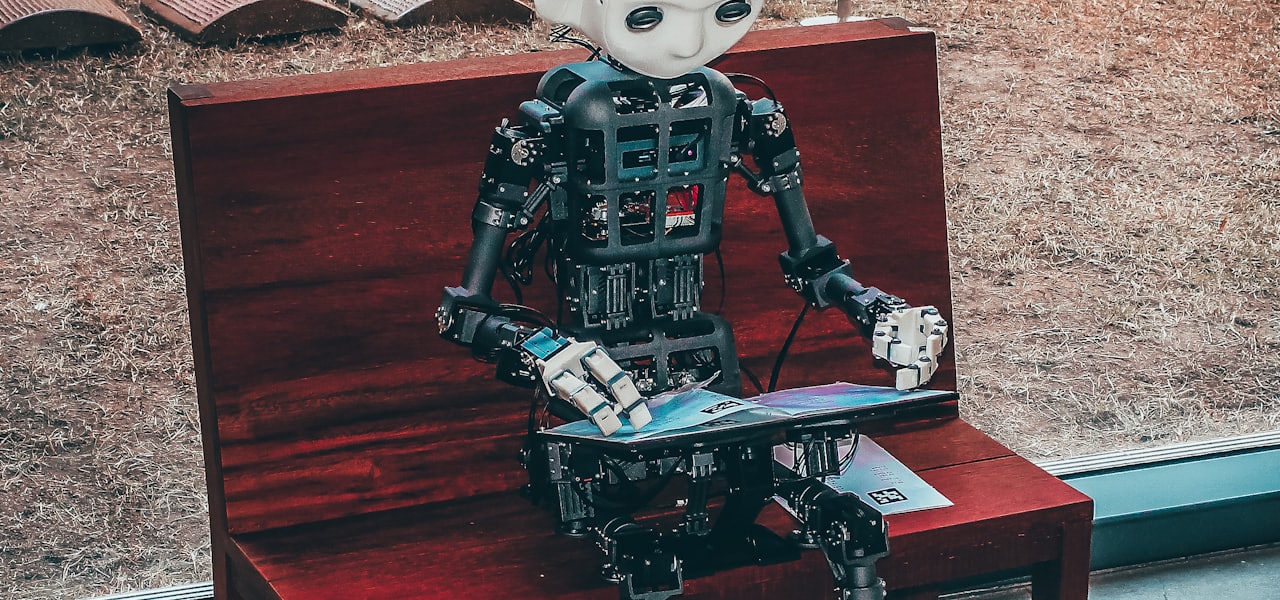
A cyborg () is a being with both organic and biomechatronic body parts. It is a portmanteau of cybernetic and organism. The term was coined in 1960 by Manfred Clynes and Nathan S. Kline. In contrast to biorobots and androids, the term cyborg applies to a living organism that has undergone restoration of function or enhancements of abilities due to the integration of some artificial component or technology that relies on feedback. == Description and definition == Alternative names for a cyborg include cybernetic organism, cyber-organism, cyber-organic being, cybernetically enhanced organism, cybernetically augmented organism, technorganic being, techno-organic being, and techno-organism. Unlike bionics, biorobotics, or androids, a cyborg is an organism that has restored function or, especially, enhanced abilities due to the integration of some artificial component or technology that relies on some sort of feedback, for example: prostheses, artificial organs, implants or, in some cases, wearable technology. Cyborg technologies may enable or support collective intelligence. A related idea is the "augmented human". While cyborgs are commonly thought of as mammals, including humans, the term can apply to any organism. === Placement and distinctions === D. S. Halacy's Cyborg: Evolution of the Superman (1965) featured an introduction which spoke of a "new frontier" that was "not merely space, but more profoundly the relationship between 'inner space' to 'outer space' – a bridge...between mind and matter." In "A Cyborg Manifesto", Donna Haraway rejects the notion of rigid boundaries between humanity and technology, arguing that, as humans depend on more technology over time, humanity and technology have become too interwoven to draw lines between them. She believes that since we have allowed and created machines and technology to be so advanced, there should be no reason to fear what we have created, and cyborgs should be embraced because they are part of human identities. However, Haraway has also expressed concern over the contradictions of scientific objectivity and the ethics of technological evolution, and has argued that "There are political consequences to scientific accounts of the world." === Biosocial definition === According to some definitions of the term, the physical attachments that humans have with even the most basic technologies have already made them cyborgs. In a typical example, a human with an artificial cardiac pacemaker or implantable cardioverter-defibrillator would be considered a cyborg, since these devices measure voltage potentials in the body, perform signal processing, and can deliver electrical stimuli, using a synthetic feedback mechanism to keep that person alive. Implants, especially cochlear implants, that combine mechanical modification with any kind of feedback response are also cybernetic enhancements. Some theorists cite such modifications as contact lenses, hearing aids, smartphones, or intraocular lenses as examples of fitting humans with technology to enhance their biological capabilities. The emerging trend of implanting microchips inside the body (mainly the hands), to make financial operations like a contactless payment, or basic tasks like opening a door, has been erroneously marketed as more recent examples of cybernetic enhancement. The latter has not yet seen significant traction outside niche areas in Scandinavia and in actual function is little more than a pre-programmed Radio-frequency identification (RFID) microchip encased in glass that does not interact with the human body (it is the same technology used in the microchips injected into animals for ease of identification), thus not fitting the definition of a cybernetic implant. As cyborgs currently are on the rise, some theorists argue there is a need to develop new definitions of aging. For instance, a bio-techno-social definition of aging has been suggested. The term is also used to address human-technology mixtures in the abstract. This includes not only commonly used pieces of technology such as phones, computers, the Internet, and so on, but also artifacts that are not usually considered technology; for example, pen and paper, and speech and language. When augmented with these technologies and connected in communication with people in other times and places, a person becomes capable of more than they were before. An example is a computer, which gains power by using Internet protocols to connect with other computers. Another example is a social-media bot—either a bot-assisted human or a human-assisted-bot—used to target social media with likes and shares. Cybernetic technologies thus include highways, pipes, electrical wiring, buildings, electrical plants, libraries, and other infrastructural constructs. Bruce Sterling, in his Shaper/Mechanist universe, suggested an idea of an alternative cyborg called 'Lobster', which is made not by using internal implants, but by using an external shell (e.g. a powered exoskeleton). The computer game Deus Ex: Invisible War prominently features cyborgs called Omar, Russian for 'lobster'. === Evolutionary perspective === In 1994, Hans Hass formulated a scientific view of the human-machine hybrids he called "hypercells". They can expand their biological cell body with artificial artifacts and thus expand their performance body. The theory of hypercells or Homo proteus, as Hass called the human-machine hybrid to distinguish Homo sapiens, extends Charles Darwin's theory of evolution and deals with the course of evolution beyond humans. In his 2019 book Novacene, James Lovelock used the term "cyborgs" to refer to the next generation of beings who will become the "understanders of the future" and "lead the cosmos to self-knowledge". While acknowledging the organic component in Clynes' and Kline's definition, he proposed that these cyborgs "will have designed and built themselves from the artificial intelligence systems we have already constructed", and used the term cyborg "to emphasize that the new intelligent beings will have arisen, like us, from Darwinian evolution." == Origins == The concept of a man-machine mixture was widespread in science fiction before World War II. As early as 1843, Edgar Allan Poe described a man with extensive prostheses in the short story "The Man That Was Used Up". In 1911, Jean de La Hire introduced the Nyctalope, a science fiction hero who was perhaps the first literary cyborg, in Le Mystère des XV (later translated as The Nyctalope on Mars). Nearly two decades later, Edmond Hamilton presented space explorers with a mixture of organic and machine parts in his 1928 novel The Comet Doom. He later featured the talking, living brain of an old scientist, Simon Wright, floating in a transparent case, and in all the adventures of his famous hero, Captain Future. In 1944, in the short story "No Woman Born", C. L. Moore wrote of Deirdre, a dancer, whose body was burned completely and whose brain was placed in a faceless but beautiful and supple mechanical body. In 1960, the term "cyborg" was coined by Manfred E. Clynes and Nathan S. Kline to refer to their conception of an enhanced human being who could survive in extraterrestrial environments: For the exogenously extended organizational complex functioning as an integrated homeostatic system unconsciously, we propose the term 'Cyborg'. Their concept was the outcome of thinking about the need for an intimate relationship between human and machine as the new frontier of space exploration was beginning to develop. A designer of physiological instrumentation and electronic data-processing systems, Clynes was the chief research scientist in the Dynamic Simulation Laboratory at Rockland State Hospital in New York. The term first appears in print 5 months earlier when The New York Times reported on the "Psychophysiological Aspects of Space Flight Symposium" where Clynes and Kline first presented their paper: A cyborg is essentially a man-machine system in which the control mechanisms of the human portion are modified externally by drugs or regulatory devices so that the being can live in an environment different from the normal one. Thereafter, Hamilton would first use the term "cyborg" explicitly in the 1962 short story, "After a Judgment Day", to describe the "mechanical analogs" called "Charlies," explaining that "[c]yborgs, they had been called from the first one in the 1960s...cybernetic organisms." The 1972 novel Cyborg by Martin Caidin introduced the character of bionic government agent Steve Austin, and was adapted into the popular television series The Six Million Dollar Man, which ran from 1973 to 1978. In 2001, a book titled Cyborg: Digital Destiny and Human Possibility in the Age of the Wearable computer was published by Doubleday. Some of the ideas in the book were incorporated into the documentary film Cyberman that same year. == Cyborg tissues in engineering == Cyborg tissues structured with carbon nanotubes and plan
Algorithmic curation
Algorithm curation is the selection of online media by technologies such as recommender systems and personalized search. Curation entails the selective sharing of online content and recommendations based on inferred interests. Curation algorithms implement different filter approaches, such as collaborative filtering and content-based filtering. Examples include search engine and social media products such as the Twitter feed, Facebook's News Feed, and Google Personalized Search. == History == === Early algorithmic curation === Online platforms use newsfeed algorithms to determine what content to present to each user. The volume of content published on social media platforms created a need for automated filtering, as manual review of all available content by users is not feasible. These systems function as a form of gatekeeper, shaping which new material users are exposed to and influencing knowledge, attention, and political exposure. ==== Information overload ==== Early ranking algorithms addressed information overload by surfacing the most recent or most popular posts. Later systems shifted toward ranking content based on predicted engagement, aiming to increase the time users spend on a platform. Research has found that these engagement-oriented systems can increase the spread of misinformation and contribute to political polarization as a side effect of optimising for user interaction. ==== How algorithm changes users' feeds over time ==== Algorithmic curation has been found to increase source diversity in some respects while simultaneously reducing the number of external links presented to users, which limits exposure to off-platform content. Research using agent-based modelling has examined how user behaviour, information quality, and algorithmic design interact with one another over time. === Emergence of AI === Platforms increasingly shifted from rule-based ranking systems toward machine-learning and AI-driven approaches, which allow feeds to be personalised at a larger scale and with greater responsiveness to user behaviour. For example, X (formerly Twitter) moved away from a chronological feed toward an AI-powered ranking system that personalises content for each user. These systems are capable of making ranking decisions across volumes of content and user interactions that would not be practical to handle manually. == Approach == === Filter types === ==== Collaborative filtering ==== Collaborative filtering (CF) methods create recommendations based on a person's usage patterns. CF predicts a person's preference for an item by matching their interests with those of users who have similar interests. This process allows for the sharing of ratings between users with similar profiles. CF is based on patterns of human behaviour rather than machine analysis of content itself. Users of CF systems rate items they have interacted with, and these ratings form a profile of interests. The CF system then matches that user with others who have similar profiles, and uses their ratings to generate recommendations. Collaborative filtering can be applied across various content types including text, images, music, and financial products, and can account for complex attributes such as taste and quality that are difficult to represent explicitly. ==== Content-based filtering ==== Content-based filtering (CBF) builds a user profile to represent the types of items a user has engaged with, based on keywords and attributes used to describe those items. Recommendations are generated by presenting items similar to those the user has previously engaged with or is currently viewing. The CBF method creates a profile for each item based on discrete attributes and features, and then constructs a content-based user profile using a weighted vector of those features derived from items the user has rated, purchased, or interacted with. The weights represent the relative importance of each feature, and can be computed using techniques such as Bayesian classifiers, cluster analysis, decision trees, and artificial neural networks, with the goal of estimating the probability that a user will engage with a suggested item. One application of content-based filtering is Pandora Radio, where users provide an artist, genre, or composer to generate a station, and the system surfaces music with similar attributes. == Technology == === Recommender system === Recommender systems rank and suggest content to users based on a combination of implicit and explicit user input. Implicit signals include time spent viewing or engaging with a specific item. Explicit signals include actions such as liking posts, saving store pages, reading news articles, or sharing content. === Personalized search === Personalized search aims to retrieve results most relevant to the user by incorporating contextual factors beyond the explicit query, such as past queries, browsing history, and inferred interests. Social media platforms such as X (formerly Twitter) and Bluesky generate recommendations based on similar users and the content those users interact with. Personalized search may also allow users to explicitly filter results by blocking content containing certain phrases or hashtags. For first-time users without prior history, personalized search may draw on content-based filtering to establish an initial context. Similar processes are used by search engines and retail platforms to tailor results and product recommendations to individual users. == AI contribution == Artificial intelligence contributes to algorithmic curation through machine-learning models capable of processing large volumes of data. Techniques such as deep learning and reinforcement learning allow curation algorithms to model user preferences with greater granularity alongside established filtering approaches. This enables platforms to adjust content rankings rapidly in response to user behaviour. In social media and streaming contexts, AI-driven systems arrange feeds according to predicted relevance, with the outputs shaped by patterns present in the training data. == Social media and potential impact == === Echo chambers === Social media algorithms, such as those used by X (formerly Twitter), recommend content that the system predicts a user will engage with positively. Content from accounts with differing perspectives is less likely to be surfaced, which may reduce source and topic diversity and contribute to the formation of echo chambers. For example, Facebook's news feed is designed to surface content aligned with users' prior engagement, which may reinforce existing views. This dynamic may contribute to filter bubbles, in which users are seldom exposed to content outside their existing interests. Users may further narrow their feeds by actively blocking certain content or accounts. === Over-representation === A pattern observed across social media platforms is the concentration of algorithmic visibility among a small subset of users. Content from the most active users, those with the largest followings, or those generating the most engagement tends to be surfaced more frequently, meaning a small number of accounts can account for a disproportionate share of what appears in other users' feeds.